


Winter Quarter 2027
- For day, time, room, and TA information, see our:
PDF Schedule or Schedule Builder - For all courses not described here, see:
Catalog Descriptions
Language Courses
- GER 002Y Elementary German | Various Instructors
Course Description: Continuation of GER 001 in areas of grammar and basic language skills.
General Education: Arts & Humanities (AH); World Cultures (WC).
- GER 021 Intermediate German | Kirsten Harjes
Review of grammatical principles by means of written exercises; expanding of vocabulary through readings of modern texts; addresses social relations and cultural practices in Germany; discusses history of Germany.
Prerequisite(s): GER 020.
General Education: Arts & Humanities (AH); Oral Skills (OL); World Cultures (WC); Writing Experience (WE).
Undergraduate Course Descriptions
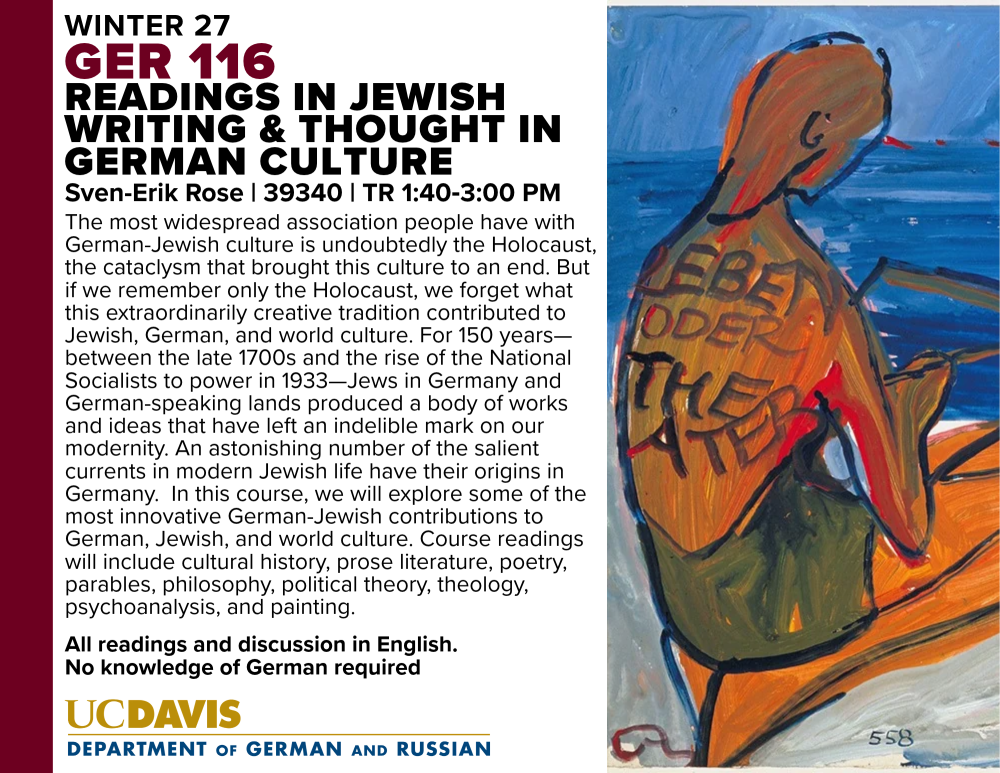
GER 116 Readings in Jewish Writing & Thought in German Culture | Sven-Erik Rose
Taught in English
The most widespread association people have with German-Jewish culture is undoubtedly the Holocaust, the cataclysm that brought this culture to an end. But if we remember only the Holocaust, we forget what this extraordinarily creative tradition contributed to Jewish, German, and world culture. For 150 years—between the late 1700s and the rise of the National Socialists to power in 1933—Jews in Germany and German-speaking lands produced a body of works and ideas that have left an indelible mark on our modernity. An astonishing number of the salient currents in modern Jewish life have their origins in Germany. The Jewish Enlightenment began in Berlin in the late 18th century with the Berlin philosopher Moses Mendelssohn. It was a Viennese playwright and journalist, Theodor Herzl, who invented political Zionism at the turn of the 19th to the 20th century. It was a Viennese Jewish doctor, a contemporary of Herzl’s—Sigmund Freud—who invented psychoanalysis. In this course, we will explore some of the most innovative German-Jewish contributions to German, Jewish, and world culture by figures, in addition to those already mentioned, such as Martin Buber, Glikl bas Reb Leyb, Heinrich Heine, Franz Kafka, Charlotte Salomon, Else Lasker-Schüler, and Rahel Varnhagen. Course readings will include cultural history, prose literature, poetry, parables, philosophy, political theory, theology, psychoanalysis, and painting.
All readings and discussion in English. No prerequisites, and no knowledge of German required. If you wish to take this course as a course taught in German for the German major or minor, this can be done through arrangement with the professor.
Cross Listing: JST 116.
General Education: Arts & Humanities (AH); World Cultures (WC); Writing Experience (WE).
GER 127 Major Writers in German | Elisabeth Krimmer
Taught in English
What does war do to the people who lived through it? What moral questions arise in the context of war? What kinds of resistance and violence, if any, are justified in the face of oppression? How does warfare affect the average soldier? How does it shape women’s lives on the home front? What is the responsibility of those who looked away? How can collective remembrance do justice to the victims of war?
This course examines how four major writers tackled and answered some of these questions in different historical contexts. We begin with Friedrich Schiller’s The Virgin of Orleans, which features the fifteenth-century cross-dressed peasant girl Joan of Arc, who led an army into battle. We then turn to Heinrich’s von Kleist’s Hermann’s Battle, which uses a historical setting to address the French occupation of Germany during the Napoleonic Wars; Erich Maria Remarque’s All Quiet on the Western Front deals with the unprecedented front-line experiences of the First World War, from trench warfare and barbed wire to gas masks and tanks; Günter Grass’s Crabwalk explores the remembrance of World-War Two crimes against the background of contemporary political violence. We conclude with A Woman in Berlin, a firsthand account of the sexual violence committed against women during the Soviet occupation of Berlin in 1945.
Taught in English. No Knowledge of German Required. If you wish to take this course as a course taught in German for the German major or minor, this can be done through arrangement with the professor.
General Education: Arts & Humanities (AH); World Cultures (WC); Writing Experience (WE).

GER 142 New German Cinema | Kirsten Harjes
Taught in English
This course introduces a specific period in German filmmaking called New German Cinema. NGC spans roughly two decades from the 1960s to the 1980s. Subsidized by government grants to revitalize the timid and commercially driven film industry, NGC grew into an innovative and brutally honest documentary-style cinema addressing pressing political and social struggles of its time: Germany’s struggle with former Nazis still in political power; the pervasive silence around coming to terms with the atrocities committed in World War II; the exploitation of workers by elites in industry and politics; racism against newly arriving workers from southern Europe; feminism and the fight for equal pay and legalized abortions (protesting “§218”); the LGBTQ community’s fight for legalization (protesting “§175”); and finally the slanderous power of big media conglomerates destroying lives. Many of these societal struggles are as prescient now as they were then. NGC gave rise to internationally renowned directors such as R.W. Fassbinder, Margarete von Trotta, Wim Wenders, and Werner Herzog.
Taught in English. No Knowledge of German Required. If you wish to take this course as a course taught in German for the German major or minor, this can be done through arrangement with the professor.
Cross Listing: FMS 142.
General Education: Arts & Humanities (AH); Oral Skills (OL); Visual Literacy (VL); World Cultures (WC); Writing Experience (WE).

Courses Outside of the Department
- More Elective Options for German Majors
German majors can use up to 2 courses outside of the department as electives for the major as long as the student receives approval from a GER advisor, which should be noted on the Major Checklist Form.

German Elective Course Options:
HIS 142A - History of the Holocaust
ECN 160A - International Microeconomics
POL 118C - History of Political Theory: Late Modern